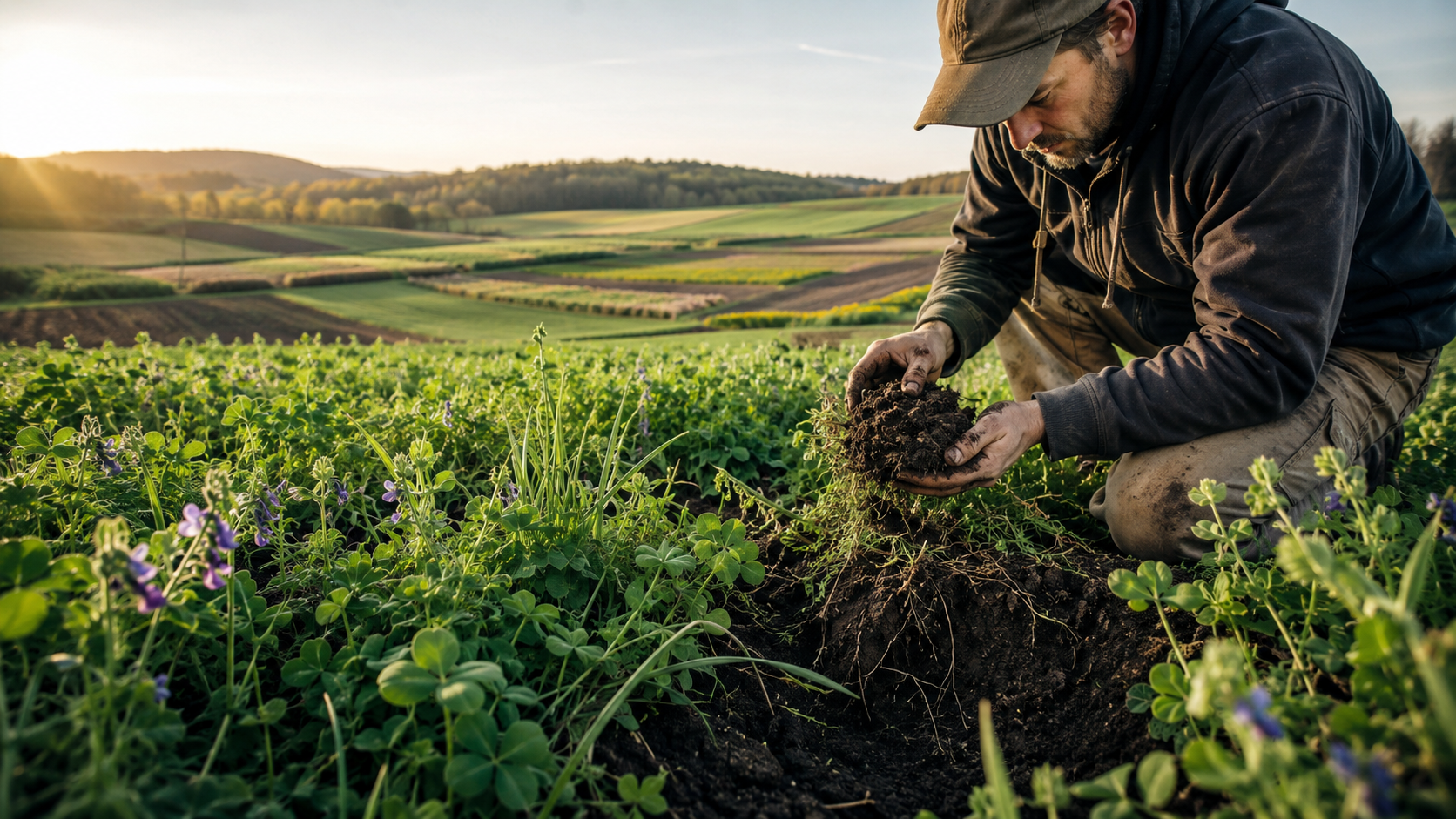
For most of the last century, farming treated soil as little more than a passive medium, a substrate to hold plants upright while fertilizer and water did the real work. The results were spectacular harvests and, beneath them, a slow crisis: eroding topsoil, declining fertility, and land that grew more dependent on chemical inputs with each passing season. Regenerative agriculture turns that thinking on its head. Instead of asking what we can extract from the soil, it asks how farming can leave the soil healthier than it found it. And one of its most powerful, least glamorous tools is the cover crop, a plant grown not to be sold but to feed the land itself.
The core idea behind regenerative agriculture is that healthy soil is not dirt but a living system, teeming with bacteria, fungi, earthworms, and countless other organisms whose activity determines whether land thrives or declines. Conventional intensive farming, with its heavy tillage and synthetic inputs, tends to degrade that living system over time. Regenerative farming works in the opposite direction, using a connected set of practices to rebuild it: minimizing soil disturbance, keeping living roots in the ground year-round, returning organic matter to the earth, and relying on natural processes rather than purchased chemicals wherever possible. The goal is a virtuous cycle in which biology, not bottled nitrogen, drives fertility.
Cover crops sit at the heart of this approach, and understanding what they do reveals why the whole philosophy works. A cover crop is something like clover, rye, vetch, or a mix of species, planted in the gaps between cash crops, during the off-season or alongside the main harvest, specifically to protect and enrich the soil rather than to be sold. Bare soil, the default state of a conventional field after harvest, is vulnerable soil. It bakes in the sun, washes away in the rain, and loses its structure. A living cover changes everything about that exposed ground.
The benefits stack up in ways that reinforce one another. First, cover crops armor the surface against erosion, their roots binding the soil and their foliage breaking the force of rain that would otherwise carry topsoil away. Second, they feed the underground economy. Living roots constantly leak sugars into the soil that feed beneficial microbes and fungi, and when the cover crop is eventually cut or left to decompose, it returns a flush of organic matter that builds the dark, crumbly, fertile structure every farmer wants. Third, certain cover crops, particularly legumes like clover and vetch, perform a small miracle: in partnership with bacteria on their roots, they pull nitrogen straight out of the air and fix it into the soil in a form plants can use, effectively manufacturing fertilizer for free. Add to this their ability to smother weeds, breaking the need for herbicides, and to hold moisture in the ground during dry spells, and the humble cover crop starts to look less like a chore and more like the engine of the whole system.
These practices rarely work alone, and regenerative farming pairs cover cropping with two close companions. The first is no-till or reduced-till farming, which means planting directly into the soil without plowing it. Tillage may look productive, but it shatters the underground structure, exposes stored carbon to the air, and disrupts the fungal networks that healthy soil depends on. Leaving the soil intact lets those networks flourish. The second is crop rotation and diversity, varying what grows in a field from season to season so that no single demand exhausts the land and a wider range of soil life is supported. Together with cover crops, these form a mutually reinforcing whole.
What lifts regenerative agriculture above mere theory is that the results are increasingly measurable, and they are striking. Long-term field trials of these combined methods have documented soil that visibly comes back to life. In one multi-year project, fields managed regeneratively saw earthworm populations climb from essentially none to robust, thriving numbers within a few years, a simple and telling sign of returning soil health. The same systems steadily increased the carbon stored in the soil while slashing the need for purchased inputs, with documented reductions of the great majority of synthetic nitrogen, herbicide, and even diesel fuel, cutting costs substantially per hectare. This points to a benefit beyond the farm gate: soil that stores more carbon is soil that pulls carbon dioxide out of the atmosphere, making regenerative agriculture one of the rare climate strategies that can also improve a farmer’s bottom line.
It would be dishonest, though, to present this as a guaranteed miracle, and the credible case for regenerative farming includes its limits. The evidence is strongest for improved soil structure, reduced erosion, and greater resilience in dry conditions, while claims about dramatic yield increases are more contested and depend heavily on local climate, soil type, and how the practices are applied. Large mechanized farms have often adopted these methods more successfully than smallholders with fewer resources, and the transition can involve a few lean years as the soil rebuilds before the benefits fully arrive. Regenerative agriculture is a long game, not an overnight fix, and honest advocates say so.
Still, the direction it points is compelling, especially as farmers confront erratic weather, rising input costs, and the long shadow of soil degradation. The genius of the approach is that it aligns the farmer’s interest with the land’s: practices that rebuild fertility also tend to cut costs, store water, and buffer against drought. A cover crop sown into a tired field is a small act with outsized consequences, a quiet investment in the living foundation that all food ultimately rests on. After a century of treating soil as something to be used up, regenerative farming offers a different bargain, one where the land and the people who work it can both grow richer together, season after season.